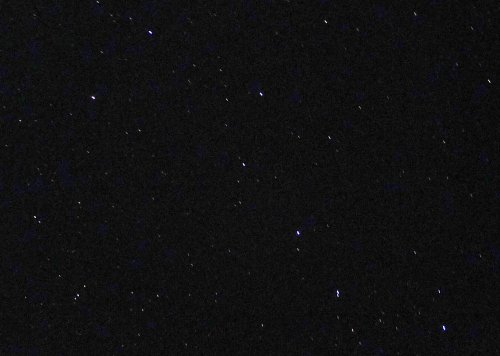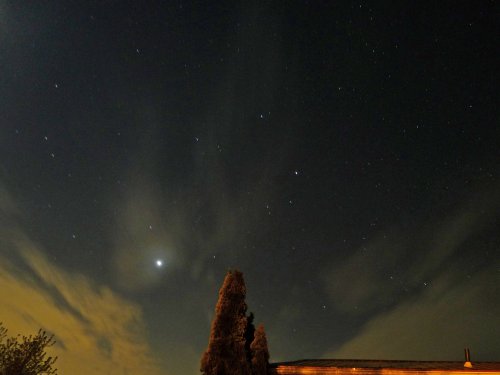
Last Friday night, I was outside taking pictures of the starry sky for yesterday’s Wordless Wednesday post. The camera is a Panasonic DMC-TZ5 point-and-shoot model. I bought this for Sylvia when her Olympus 35mm camera died a few years ago. Since then, I probably use it more than she does. I like the nine mega-pixel resolution. (That’s mostly why my Canon S1-IS (three mega-pixel) camera sits on the shelf most days–and nights.)
The camera has automatic settings for various scenes (modes). I’ve used the “burst” modes to capture the action in the pool when Briana was playing water polo. I’ve taken lots of night time shots using the “Night Scenery” mode. Lately, I’ve been experimenting with the “Starry Sky” setting. This allows for 15, 30 or 60 second time exposures. I used the 15 sec exposure for some shots of the evening sky, but it wasn’t enough to capture a good image of a particularly dark patch of sky. I wanted to try again using a 60 sec exposure. That’s why I was out last Friday evening.
I had taken the photos that were posted here yesterday. While looking around the sky, I saw a west-bound plane high overhead. I quickly repositioned the camera and captured this image:
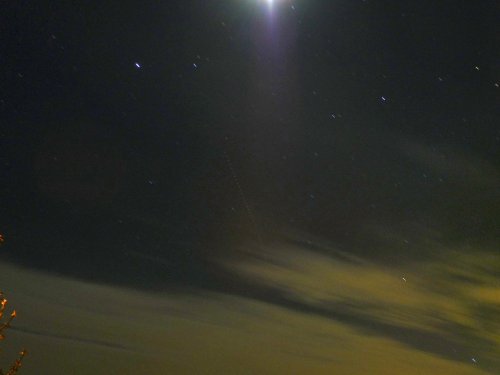
An airplane flies through the center of this picture (60 sec exposure).
Star “trails” are visible because of their relative (to Earth) motion during the 60 sec exposure time. If you look carefully in the center of the picture, you should be able to see the dotted line caused by the plane’s blinking collision-avoidance lights. The clouds are illuminated by the crescent moon, which is just out of the frame above this image.
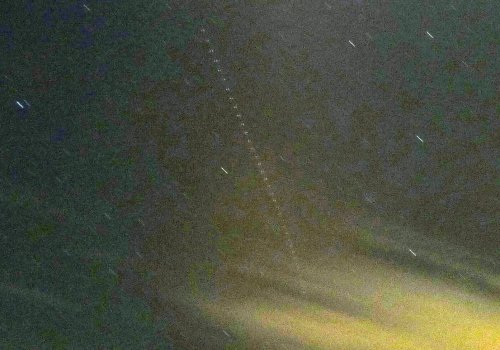
Closer view of the plane passing overhead.
How could I not be pleased with this image? Okay, a polar mount with sidereal clock drive to accurately follow the movement of the stars would be nice. I used to have one of those and a large telescope to go with it. I sold it years ago, but had a lot of fun with it. Then came the Hubble Space Telescope. I can view the most fabulous images on nasa.gov.
When I was in High School, I was given a college astronomy text book. That was great! They even had a photo of Saturn and it’s rings. The image of Saturn was as big around as the end of a pencil. It was much better than I could see–even with my four-foot long telescope. Now we’ve sent space craft flying right by it all–taking pictures and relaying them to us here on the home planet. How cool is that?